

- Published on 22 June 2026
Contents
- Introduction
- The Social Function of Private Property
- Public Benefit Works
- Public Benefit Declaration
- Determining Compensation
- Delays and Nonpayment of Compensation
- Recommendations
- Research Team
- Notes and Sources
Introduction
The government of Egypt has greatly expanded in the construction of public infrastructure projects over the last decade, including tens of bridges, inner-city highways, and expanding public transport, trains, and urban redevelopment.1 These projects are defined by law as of public benefit (public interest), where the premise is that they will improve the lives of the wider public. However, public benefit also means that there is a social cost borne by the owners and residents that must give up their property for these projects to be implemented, which can affect thousands on an annual basis.2
In Egypt, this process is regulated by the Expropriation for Public Benefit Law 10/1990, also referred to as eminent domain in the United States, or compulsory purchase in the UK, where it grants the government authority to seize private property if it deems that it serves the wider public’s interest to do so, in exchange for compensation. In light of the widespread use of expropriation, the Built Environment Observatory presents an in-depth analysis of the Expropriation Law, with recommendations for reform, aiming to balance expropriation powers against the social burdens associated with such powers.
Access the Expropriation legislation archive here
The Social Function of Private Property
The government’s right to seize property is not unique to Egypt. International law recognizes that states have a sovereign right to expropriate property for economic or social purposes, but only under strict conditions: It must serve a genuine public purpose, be non-discriminatory, follow due process, and be accompanied by compensation.3 That being said, seizing private property is globally controversial. Many countries and international financial institutions have gradually reformed expropriation powers in response to their unpopularity – albeit more often than not, reform is undertaken to appease investors and funders rather than populations affected or at risk of being affected.
Formally, the right to own private property is constitutionally protected by Article 35, which states that “Private property is protected… and may not be expropriated except for the public good and with just compensation that is paid in advance as per the law.”4 Additionally, the social function of private property was established by the prominent legal scholar Abd al-Razzaq al-Sanhuri as a founding principle of Egypt’s Civil Code (Law 131/1948):5
“The current civil code has assigned a social function to property… Where the right of ownership conflicts with the public interest, the public interest takes precedence… Where the owner’s right conflicts with a private interest that is more deserving of protection than the owner’s right, that interest takes precedence… after the owner has been compensated fairly.”
Expropriation is therefore meant to be exceptional: a compulsory legal transfer of ownership justified only when collective benefit clearly outweighs individual harm. Law 10/1990 regulates when and how expropriation can occur, limiting the act to projects deemed of public benefit, and in exchange for fair compensation. In theory, this means the government may only take property from individuals or small groups when doing so serves society at large and in exchange for fair compensation. In practice, however, the Law has allowed an almost infinite range of projects that are deemed to be of public benefit, that do not require a case-by-case investigation as to their extent of benefit to the public.
Public Benefit Works
The definition of public benefit totals 27 public works at the time of writing. Law 10/1990 itself originally listed seven eligible activities (Art. 2). In addition, the same article allowed for any public benefit works listed in other laws, which after a wide search, a further nine categories of public benefit works were found. Furthermore, Law 10/1990 (Art. 2) given the executive powers to add further public benefit categories beyond those originally proscribed. This authority has been invoked 11 times through Prime Ministerial decrees over the last 36 years since the Law was passed, adding to the projects and works that constitute a public benefit. Overall, the 27 projects or reasons that allow expropriation for public benefit can be banded together in seven groups comprising transportation, utilities, public services, urban redevelopment, economic activities, heritage protection, and national security (Table 1).
Table 1: Public benefit works by type and legislation as of May 2026. *PMD: Prime Ministerial Decree. See the legal archive for original copies of the legislation.
|
Works |
Detailed Legislation |
|
Transportation |
|
|
Utilities |
|
|
Public services |
|
|
Urban redevelopment |
|
|
Economic activities |
|
|
Heritage protection |
|
|
National Security |
|
Public Benefit Declaration
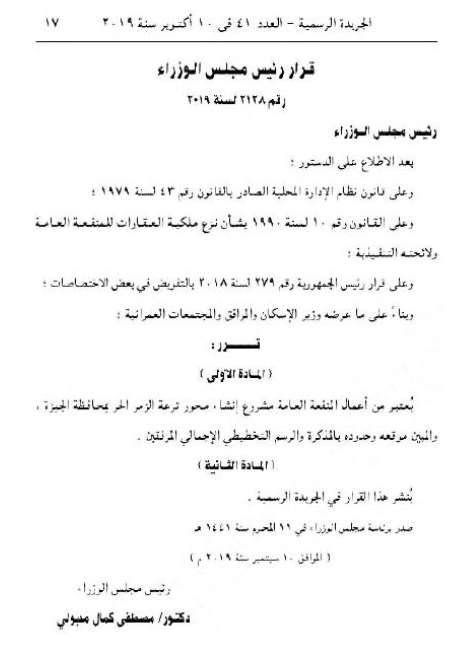
The first step taken by the government to expropriate is to declare a project as of public benefit (Art. 3). Formally issued by the President, this authority has usually been delegated to the Prime Minister,6 where as long as a project fits one of the broad categories listed above, it can be issued a public benefit decree. The decree usually has an annex prepared by the requesting agency, explaining the project, and plans and maps showing its location (Figure 1).
Figure 1: Prime Ministerial Decree announcing the Zumour Canal Axis as a public benefit project (PMD 2128/2018).
However, some concern has been expressed over the proscribed application of public benefit. A State Council judge has opined that there is an absence of clear public benefit criteria giving administrative agencies “an open hand in expropriation for any project it deemed worthy”.7 As part of technical support to the government of Egypt by the World Bank in reforming the expropriation law, the first problematic issue found with the law was how it “neither defines what it means by “public interest” nor lays out a set of criteria for its application.”8 In addition, there is no mechanism requiring the government agency requesting expropriation to demonstrate that a project is necessary, proportionate, or impossible to achieve with less or no expropriation of private property. When the law was being drafted in 1990, the parliamentary committee deliberating over the law suggested a cabinet-level technical committee that would evaluate the necessity of proposed projects, assess whether expropriation was truly required, and give the governor and Local Popular Councils an opportunity to voice concerns.9 That provision did not make it into the ratified legislation.
Furthermore, owners affected by expropriation are not allowed to legally challenge or appeal against the public benefit designation of a project. The State Council (high administrative court) has set a precedent, where as long as parliament has allowed the designation of public benefit through promulgation of the expropriation law outlining specific projects, the court cannot infringe on the legislature’s provision.10 Without mechanisms to debate the public benefit of proposed projects, and the wide definition of what constitutes a public benefit project, the designation of public benefit becomes largely administrative rather than deliberative, reducing what should be a high threshold into a routine step.
Read our Arabic guide on what to do in case of expropriation
Determining Compensation
According to Law 10/1990 (Art.6), compensation is determined at the prevailing property values at the time the expropriation order was issued. The Law also allows the choice for either monetary or in-kind compensation in exchange for expropriated property, where in-kind compensation can range from a plot of state-owned land comparable in value of that being expropriated, or, in some cases, a government-built housing unit.
The valuation of what constitutes market value and the very basis of market value as a compensation metric is problematic on several levels. According to the bylaws, a local-government committee determines the market value for a property that is being expropriated; however, a resettlement policy document for a World Bank funded project identified “substantially below the market rate” valuations in expropriation decrees highlighting a “lack of valuation experience in the Egyptian Survey Authority (ESA),” and the lack of market data.11 The valuation committees were also found to have not included professional independent evaluators, and owners cannot appoint independent experts.
Compensation is also solely for the property, and does not account for associated losses due to resettlement including for example the potential loss of income, and legal and moving fees,12 rendering it inadequate in principle. The 2018 amendment attempted to address the financial mismatch by adding a 20 percent surcharge in addition to the determined market value, as a “moral compensation because owners cannot refuse the expropriation.”13 The result is not simply displacement, but often times downward mobility, with individuals and families receiving less than adequate compensation, if any compensation at all.
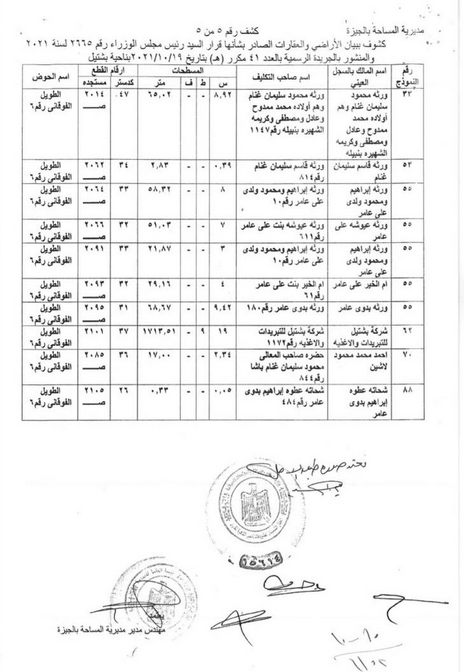
Figure 2: A sample of a table of owners names and property descriptions that are published with an expropriation decree (Minister of Housing Decree 1102/2024).
Delays and Non-payment of Compensation
Even after the new 2014 Constitution clearly stated that compensation should be paid in advance of an owner relinquishing their property to the government (Art. 35), the expropriation law mishandles the provision. The Law states that if the stated compensation is paid to the owners it is considered paid, even if the owners had lodged an appeal against it (Art. 13). Given the chronically low compensation, and how appeals could drag on in court for years, the state compensation will in all likelihood not be enough for an owner to replace their property with one of similar value, and in the case it was a home, it would be less adequate. In addition, if the compensation could not be paid to the owner for unknown reasons, it would still be considered paid upon transfer from the authority requesting expropriation, for eg. the agency for roads and bridges, to the expropriating authority, usually the survey authority (Art. 13). This calls into question what the reasons preventing payment could be, and ultimately, owners would be vacating their properties with zero compensation, as evidenced by a number of such grievances which have been raised by MPs in parliament.14 Prime Minister Mostafa Madbouly recently responded to such criticism, citing how tenure disputes between claimants over the same property have led to delays in paying out compensation.15
This brings us to how the Expropriation Law greatly limits beneficiaries of compensation to formal owners, primarily recognizing registered titles, or preliminary contracts with clear title succession. However, this narrow definition overlooks the complex realities of tenure in Egypt where officials admit that less than five percent of property is registered,16 while statistics show that an average of 75% of recently-built homes are informal.17 This means that the majority of owners are only entitled to discretionary compensation, if at all. The government has termed this form of compensation as ‘social compensation,’ valuing it recently at LE 40,000 per room, or offering a government-built housing unit. The Minister of Transport recently stratified owners and users as follows:18
– Formal ownership of land and building built with a permit: Full legal compensation
– Formal ownership of land with informally built buildings: Compensation of land values only as per legal use, in addition to social compensation. Costs of demolition and social compensation paid out to any tenants would be deducted from compensation to land owners.
– Informal ownership of land with informally built buildings: Social compensation.
Recommendations
Taken together, the law’s broad definition of public benefit, minimal procedural safeguards, and limited compensation framework require reform. Expropriation is essentially meant to be invoked in exceptional circumstances. Reform, therefore, is not about eliminating expropriation altogether. Infrastructure and public services do require land, and states have the right to retain the capacity to act in the public interest. The issue is how to ensure that this power is exercised transparently, proportionately, and fairly, ensuring actual benefit to the wider public, and zero sacrifices by the minority giving up their homes. To align Egyptian practice with constitutional mandates and international “just compensation” standards, the following reforms are proposed.
1. Public Benefit Procedure
The determination of public benefit as a discretionary administrative act, would benefit from transitioning to an evidence-based, deliberative, transparent process, which would raise the efficiency of public spending, and ensure wider public acceptance of the project.
– Evidence-based necessity studies: Expropriation decrees would be preceded by a Social, Economic and Environmental Impact Assessment that is made available to the concerned public ahead of expropriation. This study must demonstrate that the project’s public utility outweighs the private and environmental loss and, crucially, prove that no viable, less-intrusive alternatives exist. This assessment must be participatory and inclusive of residents and owners.
– Public Benefit Committee: A Parliamentary Public Benefit Committee should be established to vet expropriation requests by agencies based on a transparent social and environmental benefit matrix that balances on the one hand, all public and private interests that exist in favour of the project, and, on the other hand, the public and private interests affected by its realisation. In addition to parliamentarians, the committee would call in local MPs and councilors, as well as relevant experts such as urban planners, economists, and environmentalists to provide insights.
– The right to judicial suspensory effect: Based on the deliberative nature of public benefit, legislation should be amended to allow for appeals against the public benefit claim of a project, and with it the freezing of expropriation and eviction until a final judicial ruling is reached regarding the legitimacy of a public benefit claim.
2. Recognition of Informal Ownership
Given that a significant portion of Egypt’s property is informally held, while the government has allowed for legalization of informal tenure and construction, these rights must be synchronized with that of the state to expropriate:
– Synchronization with Real Estate Registration Law: Full ownership rights must be recognized if owners hold evidence that would allow registration as allowed by the current law, or, in the case an application has been made but is still pending at the time of expropriation. Expropriation should be frozen, and these applications should be fast-tracked and completed in order for it to resume.
– Synchronization with Formalization Laws: Full ownership rights must be recognized if owners applied for reconciliation of informal buildings as per Law 187/2023, or of informally held land, and have applications pending at the time of expropriation. Expropriation should be frozen, and these applications should be fast-tracked and completed in order for it to resume.
– Formalization of Use Rights Compensation: Tenants and long-term lessees (under 59 year/ open/ Old Rent contracts) should receive compensation that is calculated in line with the values of remaining use under those contracts, in addition to relocation costs.
– Replacement value over market payout: Compensation should not be a mere cash settlement often eroded by inflation. It should aim for replacement value, ensuring that displaced families are provided with alternative housing of equivalent quality and location, preserving their access to livelihoods and social networks.
– A Home for a Home: Ultimately, in all cases, expropriation should not lead to homelessness or less adequate housing, where a home should be replaced with a permanent home for any resident in keeping with the Right to Housing enshrined in Article 78 of the Constitution.
3. Compensation Reform
The law should grant wider safeguards to address grievances regarding undervalued, delayed payouts; the following reforms are essential:
– Independent fair compensation valuation: Monetary compensation valuations must be determined in consultation with independent, certified private-sector real estate appraisers, along with a committee assessing social and economic damages and potential losses. Compensation must expand to include disturbance costs– moving and relocation allowances, loss of business income (goodwill) for commercial tenants, crop compensation for farmers for both current harvests and future loss of soil productivity.
– Payment-first mandate: In all cases 100% of the compensation value should be paid before eviction and relinquishing of property. In cases of appeal against the proposed compensation, eviction should be paused until a final court ruling is made and 100% of the final compensation as ruled by court is paid. A fixed deadline for specialized rapid courts to rule on such appeals could be introduced to hasten proceedings, for example 12 months.
Research Team
Written by: Nadine Abd El Razek and Yahia Shawkat
When citing this study, please reference it as follows:
Nadine Abd El Razek and Yahia Shawkat. Egypt’s Expropriation Law: Three Recommendations for Reform. The Built Environment Observatory. June 22, 2026.
Notes and Sources
1 “Expropriation in Egypt in Six Stats“. Built Environment Observatory, 6 February, 2026.
2 “Expropriation in Egypt in Six Stats“. Built Environment Observatory, 6 February, 2026.
3 UNCTAD, Expropriation: UNCTAD Series on Issues in International Investment Agreements (2012), https://unctad.org/system/files/official-document/unctaddiaeia2011d7_en.pdf.
4 The Egyptian Constitution. Arab Republic of Egypt. 2014. https://www.constituteproject.org/constitution/Egypt_2014
5 Abd al-Razzaq al-Sanhuri. “Al-Wasit fi sharh al-qanun al-madani al-jadid. Volume Eight.” Dar Ihya’ al-turath al-’arabi: Beirut, 1967. p546.
6 Most recently by Presidential Decree 279/2018.
7 Ahmed Tarek Al-Ahwal & Omar Essam El-Qusy. “Feasibility of market value as criterion for fair compensation: Expropriation in ancient Cairo (Arabic).” Arab Land Initiative, 2022. p25.
8 Chaogang Wang. “Egypt – Policy Note on Public Land Acquisition and Institutional Reforms: application of eminent domain principles.” World Bank: Washington D.C. October, 2017. p72.
9 Law 10/1990. Report of the Joint Parliamentary Committees on Constitutional Affairs, Housing, Agriculture, and Local Administration, Art. 3. In: Ahmed Tarek Al-Ahwal & Omar Essam El-Qusy. “Feasibility of market value as criterion for fair compensation: Expropriation in ancient Cairo (Arabic).” Arab Land Initiative, 2022.
10 Egypt State Council. Case 3956/55, 23 March 2014.
11 “Updated Resettlement Policy Framework for Nubaria-Metnama Gas Pipelines, Egypt.” World Bank:Washington D.C. 2016. p72.
12 Ahmed Tarek Al-Ahwal & Omar Essam El-Qusy. “Feasibility of market value as criterion for fair compensation: Expropriation in ancient Cairo (Arabic).” Arab Land Initiative, 2022. p25-26.
13 Law 24/2018 Amending Expropriation for Public Benefit Law 10/1990. Report of the Joint Parliamentary Committees on Local Administration, Budget, Housing, and Constitutional Affairs.
14 “Urgent parliamentary action regarding delays in the payment of compensation for expropriation for public benefit (Arabic)” Al-Masry Al-Youm, 16 March, 2026, and: “Parliamentarian Ahmed Nasser calls for a review of expropriation compensation in public benefit projects (Arabic)” Parlamany, 16 May, 2026, and: “Parliamentarian Sanaa El-Said submits a parliamentary inquiry regarding delays in compensation payments for land expropriation for public benefit projects (Arabic)” Al-Ahaly, 12 May, 2026
15 “Prime Minister Reveals Reason for Delayed Compensation from Expropriation (Arabic).” Al-Watan, 17 April 2025.
16 “Minister of Justice: 95% of Buildings in Egypt Unregistered (Arabic)”. Al-Ahram, 20 December, 2020.
17 “Who Build Egypt’s Housing 2024”. Built Environment Observatory, 12 May 2026.
18 “Minister of Transport: Compensation Home Owners Affected by Road Widening at LE 40,000 Per Room, (Arabic).” Al-Shorouk, 26 February 2021.